Fletcher sends Travis the birthday photo
Big BrotherFletcher sends Travis the birthday photograph of Pandora’s family, an apparently ordinary act that turns Edison’s changed body into news for a father from whom he and Pandora have kept it. The photograph provokes Edison’s abrupt withdrawal from a phone call with Travis and a confrontation with Fletcher, while exposing the difference between making a family member visible and respecting the family’s shared decision about what to disclose.
The photograph and the call
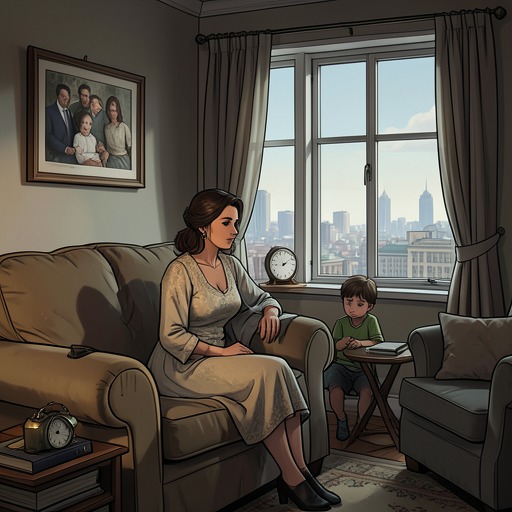
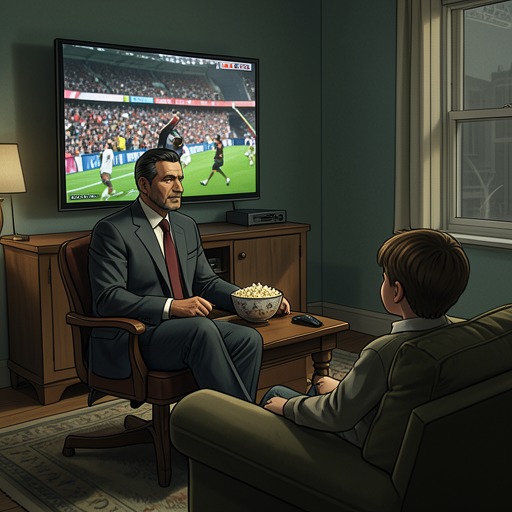
Travis calls Pandora after Fletcher has emailed him a group photograph taken for her birthday. He apologizes for missing the day, explaining that he had been occupied with fan mail, and calls the picture a kind gesture by Pandora’s carpenter husband. The call then becomes an opportunity to speak with Edison, who is staying at Pandora’s home. Pandora passes him the phone while she returns to cooking; Edison, seated in his recliner and finishing the dessert leftovers, begins by describing his musical plans. He says he is due to leave for New York on Tuesday and then tour Europe, but breaks off when he hears Travis hooting through the receiver.
Edison ends the call without hearing more. His response makes clear that Travis has used the photograph to comment on his weight: Edison tells Fletcher that he had to email that picture, then describes what Travis now knows—that his son has become, in Travis’s phrase, “a human parade float.” Pandora apologizes to Edison. Fletcher responds by asking whether Travis would not already know that Edison had a serious appetite, a reply that turns the episode from a question of inadvertent disclosure into an argument about what the photograph was meant to reveal.
Visibility, privacy, and retaliation
Edison argues that Travis does not follow his life closely and would not otherwise have learned how much his appetite had changed. He says he actively manages the image of himself available to the public: he checks his Wikipedia page each day to ensure it still uses a photograph from five years earlier, and points to the many photographs on his website and Facebook page, none showing him above 165 pounds. The image Fletcher sent therefore does more than record a family gathering. It contradicts the carefully maintained older public image Edison has tried to preserve.
Fletcher rejects the idea that the photograph itself creates the truth. He argues that a person cannot conceal what he looks like and that taking a family picture required him to step back to fit Edison into the frame. Edison counters that there is a difference between the inevitable discovery of a change and deliberately putting that change in front of a father who need not know. Their disagreement centers on control over information as much as on appearance: Edison sees the email as a deliberate exposure, while Fletcher presents it as an ordinary birthday gesture and a disclosure that could not be avoided forever.
The quarrel also reactivates an earlier dispute over Fletcher’s chair. Edison accuses Fletcher of trading his dignity for the chair, framing the photograph as payback for that conflict. Fletcher denies that sending a birthday picture to his father-in-law was retaliation. The exchange shows how the image acquires a personal history beyond its immediate occasion: for Edison, it appears tied to a prior injury in the brothers-in-law’s relationship, while Fletcher insists on the ordinary motive of including Travis in a family birthday.
The family secret and its consequences
After Edison leaves the room, Pandora asks Fletcher directly whether he sent the photograph on purpose to ensure Travis knew how large Edison had become. Fletcher answers that Travis was bound to find out sooner or later. Pandora objects that he did not have to find out from Fletcher. She explains that she has told Travis—and her sister Solstice—nothing about Edison’s change or his financial problems. She has described him only as being between apartments and staying with her during the gap so they could catch up.
Pandora’s account gives the photograph a broader consequence: Fletcher has crossed a boundary around information she had deliberately kept within the household. She argues that siblings do not disclose such matters about a brother, and that the same discretion should extend to a brother-in-law. Fletcher replies that Pandora is forgetting he has a family too. Their disagreement is not simply between truth and concealment; it is a conflict over who has standing to decide what relatives are told, and whether marriage creates obligations that can override the sibling bond.
Fletcher maintains that the central problem is Edison’s appearance, not Travis’s knowledge, and asks why Pandora always takes her brother’s side rather than his. Pandora’s defense of Edison thus becomes a marital dispute about loyalty, while the email remains its concrete point of origin. The photograph cannot be taken back, and Edison’s attempt to end the call cannot restore his control over what Travis has seen. By turning an everyday birthday snapshot into a disclosure, Fletcher’s action brings the family’s unspoken rules about privacy and protection into open conflict.